 https://lucyrx.com/wp-content/uploads/2026/10/featured-image-3.png
536
800
Kyrstin Hensley
/wp-content/uploads/2025/03/LucyRx-Logo-Primary.svg
Kyrstin Hensley2026-10-22 14:27:012026-10-22 14:43:11What Makes a Pharmacy Benefit Solution Easier for TPAs to Stand Behind?
https://lucyrx.com/wp-content/uploads/2026/10/featured-image-3.png
536
800
Kyrstin Hensley
/wp-content/uploads/2025/03/LucyRx-Logo-Primary.svg
Kyrstin Hensley2026-10-22 14:27:012026-10-22 14:43:11What Makes a Pharmacy Benefit Solution Easier for TPAs to Stand Behind?Guides & Toolkits
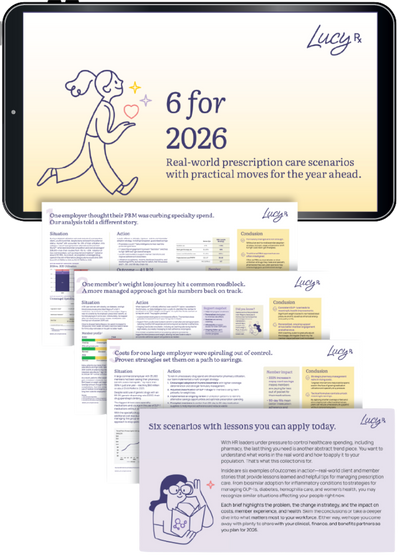
Six employer-tested PBM strategies for controlling pharmacy cost, improving transparency, and delivering better member outcomes in 2026.
GLP-1 growth, specialty drug spend, and opaque PBM practices are forcing employers to rethink how pharmacy is governed, not just how it is priced.
6 for 2026 shares six real employer and member scenarios that show how organizations are managing:
- GLP-1 utilization and cost exposure
- Specialty drug growth
- Biosimilar adoption
- Women’s health and menopause care
- PBM transparency and accountability
Each scenario highlights the challenge, the strategy shift, and the impact on cost, access, and member experience, so you can quickly see what actually works in today’s pharmacy landscape.
Want a clearer view of your pharmacy benefit?
LucyRx works with employers, brokers, and consultants to apply these prescription care strategies to real pharmacy data, helping leaders understand where cost, access, and outcomes are aligned, and where they are not.
https://lucyrx.com/wp-content/uploads/2026/10/featured-image-3.png
536
800
Kyrstin Hensley
/wp-content/uploads/2025/03/LucyRx-Logo-Primary.svg
Kyrstin Hensley2026-10-22 14:27:012026-10-22 14:43:11What Makes a Pharmacy Benefit Solution Easier for TPAs to Stand Behind? https://lucyrx.com/wp-content/uploads/2026/10/featured-image-2.png
536
800
Lisa Hazen
/wp-content/uploads/2025/03/LucyRx-Logo-Primary.svg
Lisa Hazen2026-10-22 14:20:522026-10-22 14:20:52When Women’s Health Reaches the Prescription, the Pharmacy Benefit Still Has Work to Do
https://lucyrx.com/wp-content/uploads/2026/10/featured-image-2.png
536
800
Lisa Hazen
/wp-content/uploads/2025/03/LucyRx-Logo-Primary.svg
Lisa Hazen2026-10-22 14:20:522026-10-22 14:20:52When Women’s Health Reaches the Prescription, the Pharmacy Benefit Still Has Work to Do https://lucyrx.com/wp-content/uploads/2026/10/featured-image-5.png
536
800
Kyrstin Hensley
/wp-content/uploads/2025/03/LucyRx-Logo-Primary.svg
Kyrstin Hensley2026-10-22 11:36:232026-10-22 11:51:40PBM Flexibility Is Not the Same as Control: What TPAs Should Test
https://lucyrx.com/wp-content/uploads/2026/10/featured-image-5.png
536
800
Kyrstin Hensley
/wp-content/uploads/2025/03/LucyRx-Logo-Primary.svg
Kyrstin Hensley2026-10-22 11:36:232026-10-22 11:51:40PBM Flexibility Is Not the Same as Control: What TPAs Should Test https://lucyrx.com/wp-content/uploads/2026/10/featured-image-4.png
536
800
Kyrstin Hensley
/wp-content/uploads/2025/03/LucyRx-Logo-Primary.svg
Kyrstin Hensley2026-10-20 16:30:122026-10-20 16:30:12Implementation Is Part of the Sale: What TPAs Should Test Before Recommending a PBM
https://lucyrx.com/wp-content/uploads/2026/10/featured-image-4.png
536
800
Kyrstin Hensley
/wp-content/uploads/2025/03/LucyRx-Logo-Primary.svg
Kyrstin Hensley2026-10-20 16:30:122026-10-20 16:30:12Implementation Is Part of the Sale: What TPAs Should Test Before Recommending a PBM https://lucyrx.com/wp-content/uploads/2026/09/Employer-benefits-leader-evaluating-specialty-pharmacy-performance.png
536
800
Kyrstin Hensley
/wp-content/uploads/2025/03/LucyRx-Logo-Primary.svg
Kyrstin Hensley2026-09-21 08:00:232026-09-15 13:55:18How Should a Specialty Pharmacy Earn Its Role?
https://lucyrx.com/wp-content/uploads/2026/09/Employer-benefits-leader-evaluating-specialty-pharmacy-performance.png
536
800
Kyrstin Hensley
/wp-content/uploads/2025/03/LucyRx-Logo-Primary.svg
Kyrstin Hensley2026-09-21 08:00:232026-09-15 13:55:18How Should a Specialty Pharmacy Earn Its Role? https://lucyrx.com/wp-content/uploads/2026/09/Employer-reviewing-a-pharmacy-benefits.png
536
800
Kyrstin Hensley
/wp-content/uploads/2025/03/LucyRx-Logo-Primary.svg
Kyrstin Hensley2026-09-16 08:04:472026-09-15 13:54:06Projected Savings vs. Realized Savings: What Employers Should Ask
https://lucyrx.com/wp-content/uploads/2026/09/Employer-reviewing-a-pharmacy-benefits.png
536
800
Kyrstin Hensley
/wp-content/uploads/2025/03/LucyRx-Logo-Primary.svg
Kyrstin Hensley2026-09-16 08:04:472026-09-15 13:54:06Projected Savings vs. Realized Savings: What Employers Should Ask https://lucyrx.com/wp-content/uploads/2026/08/featured-image.png
536
800
Lisa Hazen
/wp-content/uploads/2025/03/LucyRx-Logo-Primary.svg
Lisa Hazen2026-09-09 08:00:572026-09-02 12:59:22A Better Way to Think About GLP-1 Strategy
https://lucyrx.com/wp-content/uploads/2026/08/featured-image.png
536
800
Lisa Hazen
/wp-content/uploads/2025/03/LucyRx-Logo-Primary.svg
Lisa Hazen2026-09-09 08:00:572026-09-02 12:59:22A Better Way to Think About GLP-1 Strategy https://lucyrx.com/wp-content/uploads/2026/08/featured-image-3.png
536
800
Lisa Hazen
/wp-content/uploads/2025/03/LucyRx-Logo-Primary.svg
Lisa Hazen2026-09-07 08:00:382026-09-01 10:58:58Diabetes Affordability is About More Than One Prescription
https://lucyrx.com/wp-content/uploads/2026/08/featured-image-3.png
536
800
Lisa Hazen
/wp-content/uploads/2025/03/LucyRx-Logo-Primary.svg
Lisa Hazen2026-09-07 08:00:382026-09-01 10:58:58Diabetes Affordability is About More Than One Prescription https://lucyrx.com/wp-content/uploads/2026/08/featured-image-2.png
536
800
Lisa Hazen
/wp-content/uploads/2025/03/LucyRx-Logo-Primary.svg
Lisa Hazen2026-09-03 08:00:022026-09-01 10:52:28Is Your Pharmacy Benefit Still Working as Intended?
https://lucyrx.com/wp-content/uploads/2026/08/featured-image-2.png
536
800
Lisa Hazen
/wp-content/uploads/2025/03/LucyRx-Logo-Primary.svg
Lisa Hazen2026-09-03 08:00:022026-09-01 10:52:28Is Your Pharmacy Benefit Still Working as Intended? https://lucyrx.com/wp-content/uploads/2026/08/featured-image-1.png
536
800
Lisa Hazen
/wp-content/uploads/2025/03/LucyRx-Logo-Primary.svg
Lisa Hazen2026-09-01 10:37:402026-09-03 13:16:22Disclosure Won. Now What?
https://lucyrx.com/wp-content/uploads/2026/08/featured-image-1.png
536
800
Lisa Hazen
/wp-content/uploads/2025/03/LucyRx-Logo-Primary.svg
Lisa Hazen2026-09-01 10:37:402026-09-03 13:16:22Disclosure Won. Now What? https://lucyrx.com/wp-content/uploads/2026/10/featured-image-3.png
536
800
Kyrstin Hensley
/wp-content/uploads/2025/03/LucyRx-Logo-Primary.svg
Kyrstin Hensley2026-10-22 14:27:012026-10-22 14:43:11What Makes a Pharmacy Benefit Solution Easier for TPAs to Stand Behind?
https://lucyrx.com/wp-content/uploads/2026/10/featured-image-3.png
536
800
Kyrstin Hensley
/wp-content/uploads/2025/03/LucyRx-Logo-Primary.svg
Kyrstin Hensley2026-10-22 14:27:012026-10-22 14:43:11What Makes a Pharmacy Benefit Solution Easier for TPAs to Stand Behind? https://lucyrx.com/wp-content/uploads/2026/10/featured-image-2.png
536
800
Lisa Hazen
/wp-content/uploads/2025/03/LucyRx-Logo-Primary.svg
Lisa Hazen2026-10-22 14:20:522026-10-22 14:20:52When Women’s Health Reaches the Prescription, the Pharmacy Benefit Still Has Work to Do
https://lucyrx.com/wp-content/uploads/2026/10/featured-image-2.png
536
800
Lisa Hazen
/wp-content/uploads/2025/03/LucyRx-Logo-Primary.svg
Lisa Hazen2026-10-22 14:20:522026-10-22 14:20:52When Women’s Health Reaches the Prescription, the Pharmacy Benefit Still Has Work to Do https://lucyrx.com/wp-content/uploads/2026/10/featured-image-5.png
536
800
Kyrstin Hensley
/wp-content/uploads/2025/03/LucyRx-Logo-Primary.svg
Kyrstin Hensley2026-10-22 11:36:232026-10-22 11:51:40PBM Flexibility Is Not the Same as Control: What TPAs Should Test
https://lucyrx.com/wp-content/uploads/2026/10/featured-image-5.png
536
800
Kyrstin Hensley
/wp-content/uploads/2025/03/LucyRx-Logo-Primary.svg
Kyrstin Hensley2026-10-22 11:36:232026-10-22 11:51:40PBM Flexibility Is Not the Same as Control: What TPAs Should Test https://lucyrx.com/wp-content/uploads/2026/10/featured-image-4.png
536
800
Kyrstin Hensley
/wp-content/uploads/2025/03/LucyRx-Logo-Primary.svg
Kyrstin Hensley2026-10-20 16:30:122026-10-20 16:30:12Implementation Is Part of the Sale: What TPAs Should Test Before Recommending a PBM
https://lucyrx.com/wp-content/uploads/2026/10/featured-image-4.png
536
800
Kyrstin Hensley
/wp-content/uploads/2025/03/LucyRx-Logo-Primary.svg
Kyrstin Hensley2026-10-20 16:30:122026-10-20 16:30:12Implementation Is Part of the Sale: What TPAs Should Test Before Recommending a PBM https://lucyrx.com/wp-content/uploads/2026/09/Employer-benefits-leader-evaluating-specialty-pharmacy-performance.png
536
800
Kyrstin Hensley
/wp-content/uploads/2025/03/LucyRx-Logo-Primary.svg
Kyrstin Hensley2026-09-21 08:00:232026-09-15 13:55:18How Should a Specialty Pharmacy Earn Its Role?
https://lucyrx.com/wp-content/uploads/2026/09/Employer-benefits-leader-evaluating-specialty-pharmacy-performance.png
536
800
Kyrstin Hensley
/wp-content/uploads/2025/03/LucyRx-Logo-Primary.svg
Kyrstin Hensley2026-09-21 08:00:232026-09-15 13:55:18How Should a Specialty Pharmacy Earn Its Role? https://lucyrx.com/wp-content/uploads/2026/09/Employer-reviewing-a-pharmacy-benefits.png
536
800
Kyrstin Hensley
/wp-content/uploads/2025/03/LucyRx-Logo-Primary.svg
Kyrstin Hensley2026-09-16 08:04:472026-09-15 13:54:06Projected Savings vs. Realized Savings: What Employers Should Ask
https://lucyrx.com/wp-content/uploads/2026/09/Employer-reviewing-a-pharmacy-benefits.png
536
800
Kyrstin Hensley
/wp-content/uploads/2025/03/LucyRx-Logo-Primary.svg
Kyrstin Hensley2026-09-16 08:04:472026-09-15 13:54:06Projected Savings vs. Realized Savings: What Employers Should Ask https://lucyrx.com/wp-content/uploads/2026/08/featured-image.png
536
800
Lisa Hazen
/wp-content/uploads/2025/03/LucyRx-Logo-Primary.svg
Lisa Hazen2026-09-09 08:00:572026-09-02 12:59:22A Better Way to Think About GLP-1 Strategy
https://lucyrx.com/wp-content/uploads/2026/08/featured-image.png
536
800
Lisa Hazen
/wp-content/uploads/2025/03/LucyRx-Logo-Primary.svg
Lisa Hazen2026-09-09 08:00:572026-09-02 12:59:22A Better Way to Think About GLP-1 Strategy https://lucyrx.com/wp-content/uploads/2026/08/featured-image-3.png
536
800
Lisa Hazen
/wp-content/uploads/2025/03/LucyRx-Logo-Primary.svg
Lisa Hazen2026-09-07 08:00:382026-09-01 10:58:58Diabetes Affordability is About More Than One Prescription
https://lucyrx.com/wp-content/uploads/2026/08/featured-image-3.png
536
800
Lisa Hazen
/wp-content/uploads/2025/03/LucyRx-Logo-Primary.svg
Lisa Hazen2026-09-07 08:00:382026-09-01 10:58:58Diabetes Affordability is About More Than One Prescription https://lucyrx.com/wp-content/uploads/2026/08/featured-image-2.png
536
800
Lisa Hazen
/wp-content/uploads/2025/03/LucyRx-Logo-Primary.svg
Lisa Hazen2026-09-03 08:00:022026-09-01 10:52:28Is Your Pharmacy Benefit Still Working as Intended?
https://lucyrx.com/wp-content/uploads/2026/08/featured-image-2.png
536
800
Lisa Hazen
/wp-content/uploads/2025/03/LucyRx-Logo-Primary.svg
Lisa Hazen2026-09-03 08:00:022026-09-01 10:52:28Is Your Pharmacy Benefit Still Working as Intended?

Share